Key Analytical Findings
This report synthesizes data across 14 global markets, comparing physical VIP access pricing against AI inference costs. It reviews 2026 travel sentiment surveys, legislative frameworks including the EU AI Act, and hallucination rates in complex architectural environments.
The VIP Economic Friction
Physical crowd avoidance has been hyper-monetized into a luxury tier, making isolation inaccessible to the middle market.[3][10]
- Evidence chain
- Standard entry to landmarks like the Empire State Building is $44, while Sunrise VIP access is $135—a 200% premium.
- Why it matters
- AI erasure becomes the default methodology for signaling status and achieving a 'private' aesthetic without financial burden.
- Limit
- Some travelers still prioritize the 'true' physical experience over the digital artifact.
The Architectural Hallucination Paradigm
AI object removal predicts pixels based on probability, occasionally inventing non-existent architectural details when erasing large crowds.[11][12]
- Evidence chain
- Data indicates hallucination rates of 17% to 34% in complex environments, meaning AI may generate historically inaccurate masonry or structures when filling gaps.
- Why it matters
- The visual consensus of historical landmarks may degrade as hallucinated imagery floods social media.
- Limit
- Primary historical databases and official destination marketing still maintain authenticated imagery.
Legislative Asymmetry in Digital Curation
A legal double standard exists between commercial and personal AI use regarding image manipulation.[2][4][13]
- Evidence chain
- The EU AI Act mandates disclosure for commercial entities effective August 2026, while individual travelers remain unregulated for personal social media use.
- Why it matters
- User-generated content will appear more pristine and aspirational than official destination marketing, skewing public perception of landmark crowding.
- Limit
- Legal ambiguity remains regarding licensed user-generated content used by brands.
While AI detection and hallucination rates provide a baseline for current model performance, the rapid evolution of generative models means these metrics are subject to change. Furthermore, self-reported travel sentiment surveys may not perfectly align with actual consumer behavior.
The 2026 Overtourism Reality: Why Your Photos are Crowded
An analysis of the record-breaking tourism surge in Q1 2026 and its impact on the traveler experience.
The concept of the 'off-season' has effectively vanished. In the first quarter of 2026 alone, international arrivals hit a staggering 307 million, creating unprecedented saturation at global landmarks. For the modern traveler, this surge has transformed the pursuit of the perfect travel memory into an exercise in crowd management.[1]
This density comes at a steep price, both financially and psychologically. The average cost of a one-week domestic vacation has reached $1,991 per person. Despite this investment, 84% of travelers report feeling that they are paying more for a degraded, crowded experience. The gap between the aspirational marketing of travel destinations and the elbow-to-elbow reality on the ground has never been wider.[1]
The Economic and Inflationary Driver of Travel
How rising travel costs are pushing consumers toward digital solutions for premium experiences.
Travel costs have risen 7% year-over-year, leading 44% of Americans to feel that summer vacations are financially out of reach. Yet, the cultural imperative to travel remains incredibly strong, with 79% of Americans still planning trips despite the economic friction.[6][9]
Because travelers cannot easily afford to upgrade their physical itineraries to escape the crowds, they are finding alternative ways to salvage the value of their trips. Generative AI has emerged as an economic substitute for physical exclusivity, allowing budget-conscious travelers to digitally manufacture the premium isolation they cannot afford to buy on the ground.
The Cost of 'Empty': Physical vs. Digital Avoidance
A framework comparing the financial cost of VIP access to the accessibility of AI object removal.
Physical crowd avoidance has been hyper-monetized into a luxury tier. Landmarks have recognized the premium value of isolation and priced it accordingly. For example, a standard entry ticket to the Empire State Building costs $44, but a Sunrise VIP ticket—which guarantees a less crowded experience—costs $135. This 200% premium makes physical isolation largely inaccessible to the middle market.[3][10]
Faced with these prohibitive costs, travelers are shifting the burden of crowd avoidance from financial logistics to post-capture digital curation. Instead of waking up at 4:30 AM or paying triple the entry fee, visitors are taking photos in peak crowds and using AI tools to erase the tourists later. This represents a fundamental shift in how we value and capture travel memories.
- Physical Avoidance: Requires expensive VIP tickets, off-hours scheduling, and significant logistical planning.[3]
- Digital Avoidance: Requires zero logistical changes, standard entry fees, and a few seconds of post-processing.
The Authenticity Paradox and the 'Algorithmic Self'
Exploring the contradiction between the desire for authentic travel and the pursuit of synthetic perfection.
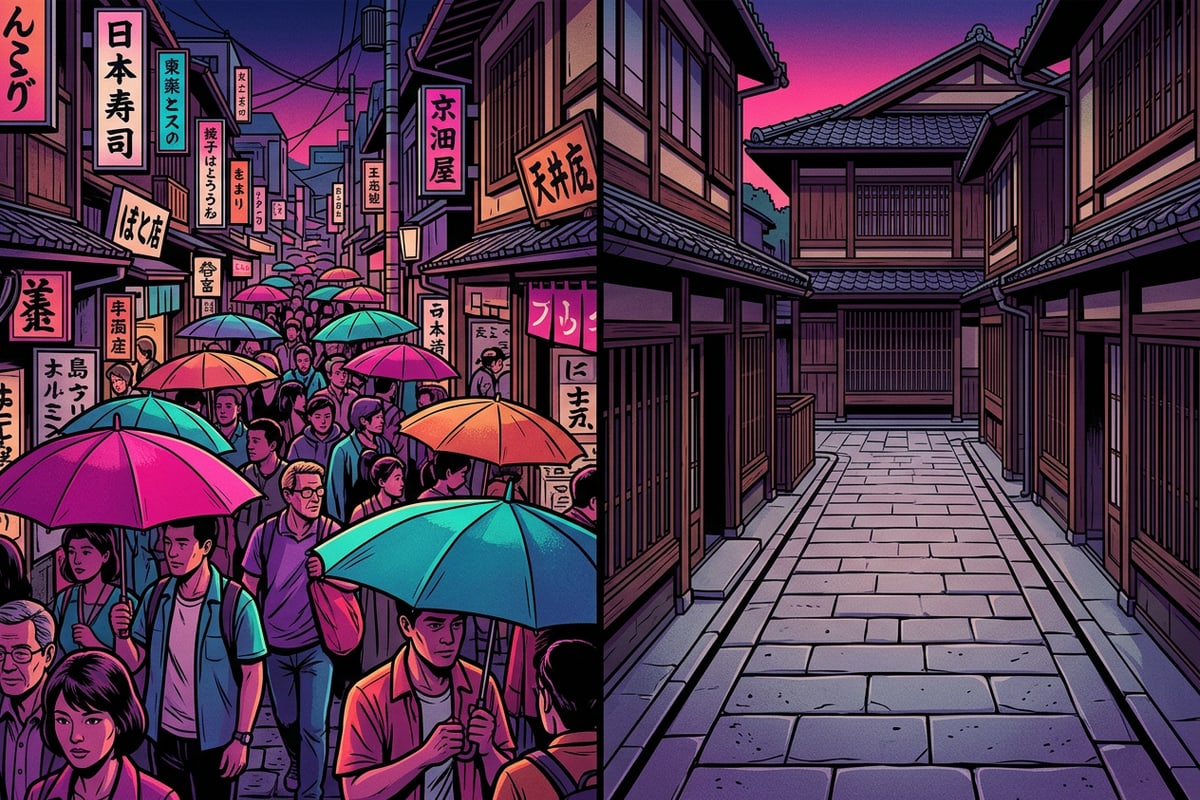
There is a fascinating contradiction at the heart of modern travel: consumers state they crave 'authentic' and human-centered experiences, yet they enthusiastically use AI to surgically remove the reality of crowds from their memories. Travelers demand physical authenticity in their itinerary but prioritize synthetic perfection in their digital documentation.
This behavior is driven by the 'Algorithmic Self.' With 76% of travelers sharing their experiences online, social media algorithms reward specific aesthetic patterns—namely, hyper-realistic, isolated depictions of famous places. The pressure to conform to these visual standards pushes users to digitally alter their reality, creating a curated version of the world that exists only on their screens.[7][8]
Workflow: Using CARA's AI Agent for Surgical Erasure
A practical guide to using CARA's AI Eraser and Conversational Photo Editing to clean up travel photos.
Achieving a pristine, crowd-free look no longer requires a degree in graphic design. The CARA app utilizes focused AI photo tools to handle the heavy lifting. The app's AI Eraser allows you to remove selected unwanted objects from a photo with AI assistance. Because the tool relies on cloud processing, it can intelligently fill in the background behind the removed tourists.
For more complex edits, CARA features Conversational Photo Editing. This allows you to edit or generate images through natural-language requests in Cara's Agent experience. You can simply ask the agent to clean up the background, though results can vary depending on the density of the crowd.
- Select the AI Eraser
Open your crowded travel photo in the CARA app and navigate to the AI Eraser tool.
- Highlight the Tourists
Carefully brush over the people or objects you want to remove. Ensure you cover their shadows as well.
- Process and Review
Allow the cloud processing to remove the objects. Note that complex backgrounds may require another attempt to get a seamless result.
Pro Tips: Outpainting and Generative Replacement
Advanced techniques for enhancing travel photos using Image Extender and AI Replace.
Beyond simple erasure, generative AI offers tools to completely reframe your travel memories. CARA's Image Extender allows you to extend an image beyond its original borders with generated surrounding content. If your photo feels too tight or claustrophobic because you had to crop out a crowd, this tool can generate additional sky, pavement, or scenery to give the image breathing room. Keep in mind that generated edge content may differ from the original scene.
Additionally, the AI Replace feature lets you replace a selected area of a photo using a text instruction. If a modern trash can or a bright neon sign is ruining the historical vibe of your shot, you can highlight it and prompt the AI to replace it with a stone planter or a vintage lamppost. The replacement result depends heavily on your selection and the specificity of your prompt.
The Architectural Hallucination Paradigm
Understanding the technical limitations and hallucination risks of AI object removal.
While AI tools are powerful, they do not possess factual knowledge of the locations you are photographing. AI object removal predicts pixels based on probability. When you erase a large group of tourists blocking a cathedral, the AI guesses what the masonry behind them looks like.
This leads to the 'Architectural Hallucination Paradigm.' Data shows hallucination rates of 17% to 34% in complex environments. The AI may invent non-existent architectural details, extra windows, or impossible structural supports. As these hallucinated images flood the internet, the visual consensus of what historical landmarks actually look like may begin to degrade.[11][12]
- AI fills gaps using probabilistic patterns, not historical blueprints.
- Complex textures like cobblestones, intricate brickwork, and wrought iron are highly susceptible to hallucination.
The Ethics of Memory: Curation vs. Reality
The legal and psychological implications of altering travel photos with AI.
As digital curation becomes the norm, a legal double standard has emerged between commercial and personal AI use. Under the EU AI Act, effective August 2026, commercial entities must disclose AI-generated content. However, individual users remain largely unregulated for personal social media use.[2][13]
This legislative asymmetry means that user-generated content will often appear more pristine and aspirational than official destination marketing. While only 5% of travelers can correctly distinguish real empty landmarks from AI-generated ones, the ethical question remains: does removing the crowds change how we remember the reality of our trips?[4][7][14]