Key Analytical Findings
The analysis compared traditional hardware stabilization (OIS/EIS) against NPR techniques, synthesized global comic market data, and evaluated the impact of Southeast Asian privacy regulations (PP Tunas) on user-generated content.
The Abstraction-Anonymity Nexus
AI stylization is evolving from a creative feature into vital compliance infrastructure.[2][7]
- Evidence chain
- Traditional blurring destroys emotional engagement; NPR decouples biometric identity from emotional resonance.
- Why it matters
- Platforms with native stylization will face lower regulatory friction.
- Limit
- Legal status of synthetic faces generated from real crowds remains untested.
Uncanny Valley Bypass
Heavy artistic abstraction accelerates market viability faster than hyper-realism.[4][6]
- Evidence chain
- Diffusion models struggle with temporal consistency; NPR lowers the cognitive expectation of photorealism.
- Why it matters
- Stylized AI delivers acceptable consumer products at lower compute costs.
- Limit
- Unsuitable for fields requiring exact geometric fidelity like forensics.
Decentralization of Screen-Ready IP
One-tap AI empowers fans to generate screen-ready IP from personal events.[1][3]
- Evidence chain
- Shift from passive watching to active remixing; growth of Instatoons on social platforms.
- Why it matters
- The locus of storytelling shifts from broadcasters to decentralized attendees.
- Limit
- Risk of market oversaturation and genre fatigue.
Legal status of synthetic faces generated from real crowds remains untested. Unsuitable for fields requiring exact geometric fidelity like forensics.
The Mosh Pit Problem: Why Your Best World Cup Clips Look Ruined
Physical limitations of smartphone optics in chaotic environments lead to unusable footage.
When a crucial World Cup goal is scored, the immediate reaction in a sports bar or stadium is pure chaos. Fans jump, lights flare, and smartphones are thrust into the air to capture the moment. However, the resulting footage is rarely the cinematic memory users hope for. To understand why, we must examine the mechanical limitations of modern smartphone cameras. Traditional Optical Image Stabilization (OIS) relies on physically moving the lens or sensor to counteract small, predictable hand tremors. Electronic Image Stabilization (EIS) complements this by cropping the frame and digitally aligning consecutive frames to smooth out motion. In a high-kinetic environment like a watch party, these hardware and software systems experience catastrophic failure.[4][5]
The erratic, multi-directional jumping of a crowd overwhelms the physical travel limits of OIS mechanisms. Furthermore, sports bars and night matches present low-light conditions that force the camera to use slower shutter speeds to gather enough light. When the camera moves violently during a slow shutter exposure, the result is severe motion blur within individual frames. Because EIS relies on finding sharp reference points to align frames, feeding it blurred frames causes the algorithm to panic, resulting in aggressive smearing, low-light grain, and jarring frame shifts.[4]
This hardware limitation creates a frustrating gap between the emotional experience of the event and the digital artifact captured. Standard video filters cannot recover lost detail in heavily blurred frames, leaving users with unshareable content that fails to capture the energy of the celebration. The data points from recent AI video generation statistics highlight that traditional hardware stabilization simply cannot keep pace with the chaotic, low-light environments typical of live sports fandom.[4][5]
The Abstraction-Stabilization Paradigm: How AI Fixes Shaky Video
Non-Photorealistic Rendering (NPR) acts as a visual corrective for motion blur.
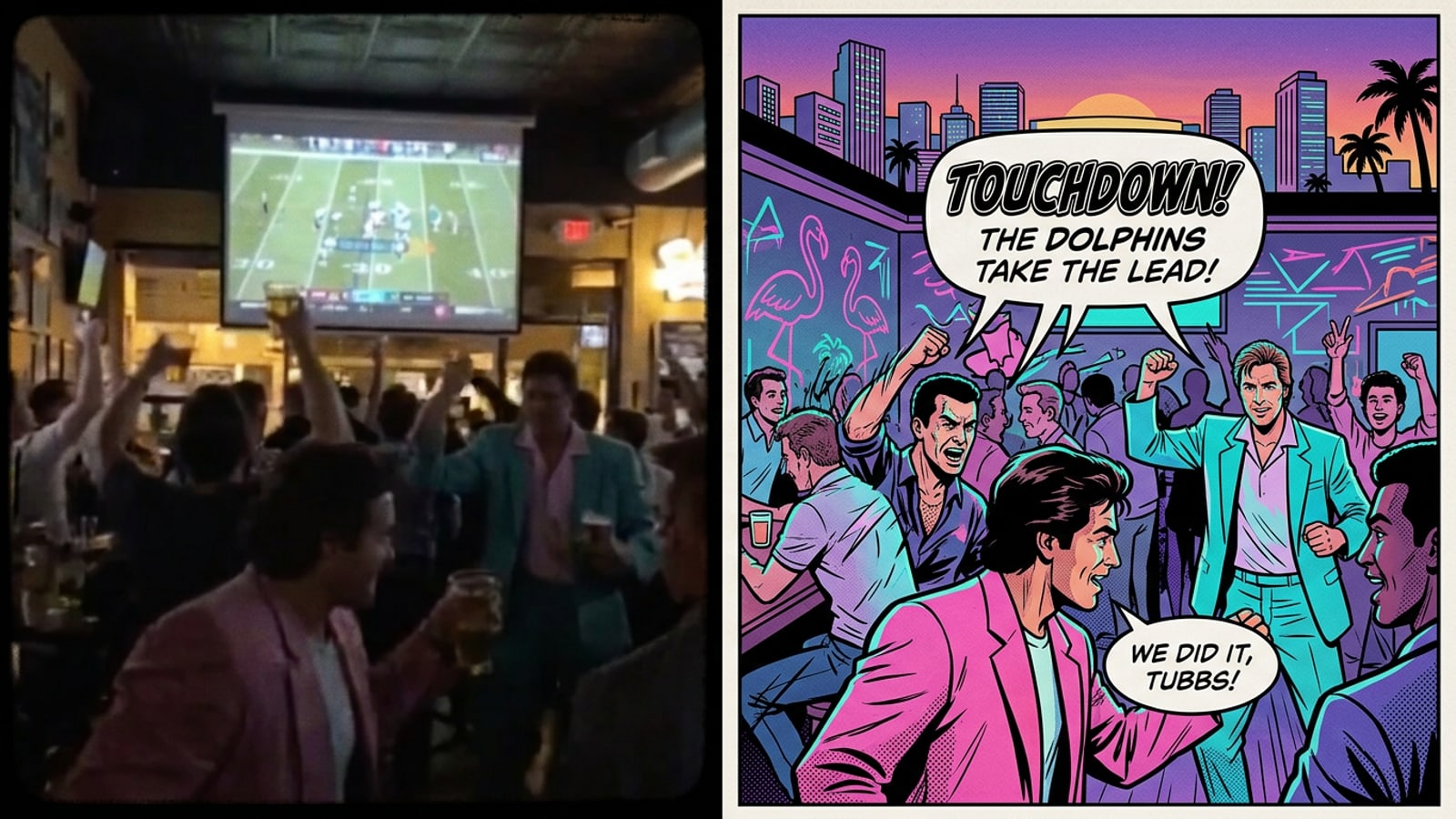
Rather than attempting to sharpen missing pixels—a computationally expensive and often futile task—modern AI video to comic apps employ Non-Photorealistic Rendering (NPR). This approach fundamentally changes the cognitive expectation of the viewer. By abstracting reality into bold ink outlines and flat colors, the AI actively masks the mechanical failures of the smartphone camera. What was once distracting motion blur is reinterpreted by the algorithm as dynamic action lines, a staple of comic book art.[4][6]
This Abstraction-Stabilization Paradigm means that AI stylization is not merely an aesthetic choice, but a structural corrective. It salvages low-fidelity footage by converting chaotic data into a stable, synthetic art style that is inherently forgiving of dropped frames and poor lighting. NPR algorithms replace blurry edges with definitive, stylized outlines through advanced edge detection techniques. Instead of trying to guess the exact boundary of a fast-moving arm, the AI draws a bold, black stroke that implies motion.[6][8][9]
Color grading is flattened through color quantization, eliminating the visual noise caused by low-light sensor grain and replacing it with vibrant, uniform hues reminiscent of cel shading or halftone printing. Motion artifacts, rather than being seen as errors, are converted into intentional artistic expressions, such as speed lines or impact bursts. This transformation is not just a filter; it is a complete re-rendering of the scene's geometry and lighting to prioritize stylistic coherence over physical accuracy.[4][10][11]
Privacy in the Crowd: Synthetic Anonymity for Social Sharing
Addressing the regulatory need for anonymizing crowds in public user-generated content.
Sharing footage of public events carries increasing legal and social liabilities. Regulations like Indonesia's PP Tunas have forced the deactivation of millions of accounts to protect user privacy, particularly for underage individuals caught in the background of viral videos. Traditional methods of anonymization, such as blurring faces or placing digital stickers over them, destroy the emotional resonance of the footage, making it unappealing for social media.[2][7]
AI video stylization offers a solution through synthetic anonymity. By transforming real faces into stylized comic characters, the AI strips away biometric identifiers while preserving the human emotion and energy of the crowd. This allows fans to share their World Cup watch party experiences globally without violating the privacy of bystanders.[2][7]
However, this Abstraction-Anonymity Nexus introduces a complex legal gray area. The legal status of synthetic faces generated from real crowds remains largely untested in global courts. If an AI generates a comic face that still bears a striking geometric resemblance to a real person, does it constitute a privacy violation under strict frameworks like PP Tunas? While the biometric data, such as exact skin texture and micro-features, is abstracted, the structural identity might still be recognizable to acquaintances. This limitation means that while AI stylization significantly lowers regulatory friction compared to raw video, it is not an absolute legal shield. Platforms and users must navigate this evolving landscape where the definition of identity in synthetic media is still being written.[2][7]
The Privacy Paradox: Balancing Utility and Security
Why users trust visual utility tools despite general AI privacy fears.
There is a documented paradox in consumer behavior regarding artificial intelligence and data privacy. While general trust in data-extractive conversational AI has seen significant drops, users willingly upload biometric-rich video to cloud services for visual stylization. Consumers differentiate between open-ended data collection and utility-based visual tools that offer an immediate, tangible benefit.[2]
In the context of sports fandom, the desire for social currency and performative engagement often outweighs abstract privacy concerns, provided the application delivers on its promise of high-fidelity stylization and functional anonymity. The willingness to engage with these tools highlights a shift in how users perceive AI: not as a monolithic surveillance entity, but as a modular utility that solves specific, localized problems like ruined event footage.[2]
Furthermore, the psychological barrier to sharing stylized content is lower. Users who might feel self-conscious about their appearance in raw, unflattering lighting are more likely to share a stylized version where they are depicted as a heroic or dynamic comic character. This Main Character Energy drives adoption, proving that privacy compliance can be successfully bundled with aesthetic enhancement.[2]
Global Trends: From Instatoons to Remix Culture
The rise of comic-style video across target markets.
The demand for stylized video is surging, driven heavily by mobile-first consumption in the Asia-Pacific region. The global comic and webtoon market is projected to grow from $7.8 billion to $28.6 billion by 2030, reflecting a deep cultural affinity for illustrated narratives. This aesthetic preference is bleeding into user-generated content, creating a new genre of Instatoons where everyday moments are remixed into graphic novel formats.[1]
In markets like Taiwan, where short-form video penetration has reached an astonishing 78.46 percent, the ability to quickly generate screen-ready intellectual property from personal events is highly valued. Fans are no longer passive consumers of sports broadcasts; they are active participants remixing their own experiences into stylized digital assets.[2][3]
This trend is particularly evident during global events like the World Cup, where the shared cultural experience provides a massive canvas for individualized digital expression. The ability to instantly convert a local watch party into a globally recognizable art style bridges the gap between personal memory and public entertainment.[1][3]
Navigating the Uncanny Valley Bypass
Heavy artistic abstraction accelerates market viability faster than hyper-realism.
One of the major hurdles in AI video generation is temporal drift, where hyper-realistic models struggle to maintain consistent geometry from frame to frame. Temporal drift typically manifests as flickering textures, morphing limbs, or backgrounds that warp unnaturally as the camera moves. In a photorealistic generation, these errors are immediately jarring because the human brain is highly attuned to the physics of the real world.[4][11]
Comic stylization bypasses this issue entirely. By lowering the cognitive expectation of photorealism, heavy artistic abstraction makes minor temporal inconsistencies feel like a natural part of the hand-drawn animation process. A flickering shadow becomes a stylistic choice; a slightly morphed limb looks like an exaggerated action pose.[6][11]
This bypass allows developers to deliver acceptable, highly engaging consumer products at lower compute costs, focusing on vibrant aesthetics rather than flawless geometric fidelity. When a user watches a stylized video of a goal celebration, they are not looking for forensic accuracy; they are looking for emotional impact. The comic book aesthetic delivers this impact while gracefully hiding the computational seams that would ruin a photorealistic attempt.[4][6]
Step-by-Step: Turning Your Watch Party into a Comic Strip with CARA
A clear workflow for using the CARA app's Video-2-Comic feature.
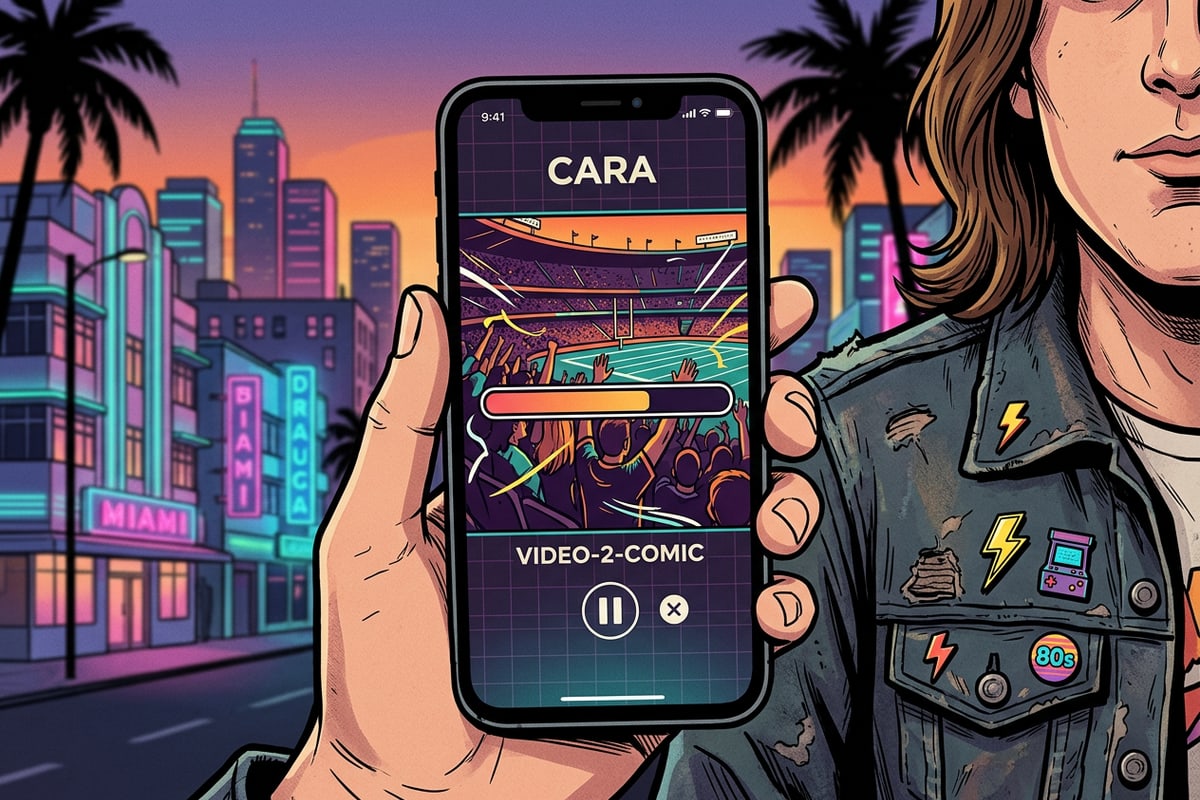
Transforming your chaotic World Cup footage into a stable comic animation is straightforward with the right tools. The CARA app, available exclusively on iOS for iPhone and iPad, utilizes a one-tap generation workflow that requires zero manual editing skills. There are no complex timelines, sliders, or brushes to manage; the cloud-based AI handles the entire stylization process.
Because the Video-2-Comic feature uses a multi-step generation workflow to ensure high-quality output, processing typically takes around five minutes. Once complete, the stylized video can be saved directly to your camera roll or shared to social media. This streamlined approach democratizes access to advanced video stylization, allowing anyone to salvage their watch party clips regardless of their technical expertise.
- Download and Open CARA
Install the CARA app from the iOS App Store and open it on your iPhone or iPad.
- Select Video-2-Comic
Choose the Video-2-Comic feature from the main menu and upload a supported video clip from your watch party.
- Choose a Template
Select a comic style template from the curated library.
- Wait for Processing
Allow approximately five minutes for the cloud AI to process the video. Do not close the app during the initial upload phase.
- Save and Share
Once generated, save the comic video to your device and share it with your network.
Decentralization of Screen-Ready IP and Fandom
One-tap AI empowers fans to generate screen-ready IP from personal events.
The democratization of AI stylization tools marks a significant shift in digital sports merchandising and fan engagement, tying directly into the broader creator economy. Fans are leveraging these tools to create personalized, high-fidelity digital artifacts that rival official merchandise. This decentralization allows attendees to craft their own narratives, turning a shaky video of a local bar celebration into a polished piece of digital art that can be monetized or used to build social followings.[1][3]
As we look toward future tournaments, the integration of these AI tools will only deepen. Whether fans are tracking player statistics or creating digital fan portraits, the ability to instantly stylize and anonymize content ensures that the fan experience remains both highly personal and globally shareable. The locus of storytelling is shifting from the broadcasters in the stadium to the decentralized attendees in the sports bars, armed with nothing more than a smartphone and an AI stylization app.[3]