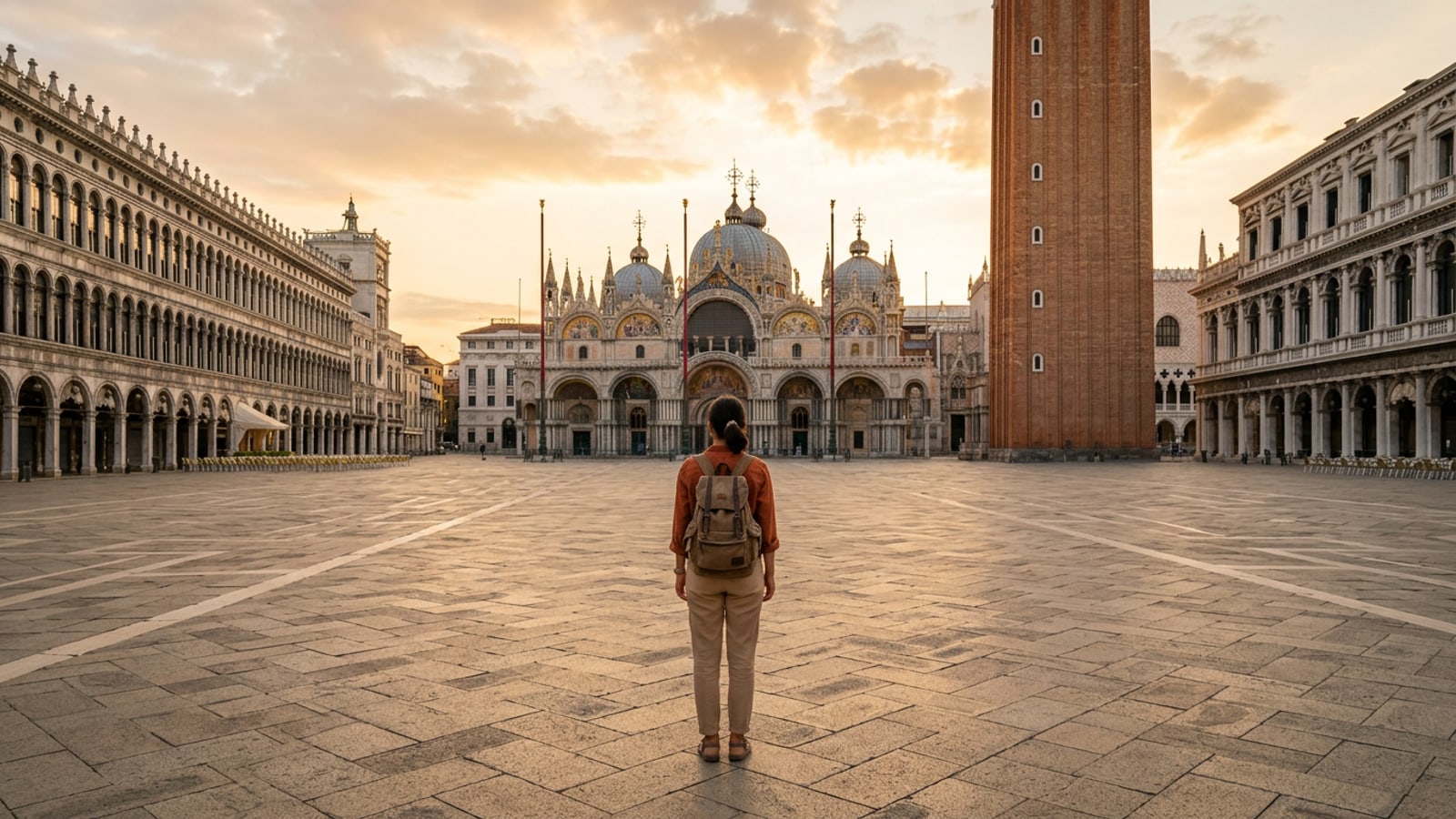
Key Analytical Findings
Comparison of municipal overtourism policies in 14 markets against AI diffusion telemetry, public opinion data, and API cost-per-edit benchmarks for generative models.
The 70/30 Rule of Authenticity
Travelers are rejecting AI-generated faces but embracing sanitized backgrounds.[6][7]
- Evidence chain
- Public opinion data and adoption rate metrics show users want to keep their own physical flaws (30% authentic proof) while using AI to remove 100% of background noise (70% polish).
- Why it matters
- AI tools must focus on background reconstruction while strictly avoiding beautification of the primary subject.
- Limit
- Requires highly sophisticated local masking that rudimentary tools often lack.
Policy-Driven Compute Consumption
Municipal restrictions directly drive cloud-based AI editing demand.[1][8]
- Evidence chain
- Hard caps at sites like Mt. Fuji displace crowds to adjacent un-ticketed areas, increasing visual congestion and subsequent object removal requests, which correlates with rising generative media API costs.
- Why it matters
- AI server load will predictably spike in correlation with new municipal access restrictions.
- Limit
- Only holds as long as international travel remains affordable.
Semantic-Spatial Friction
Natural language is an imperfect tool for describing complex spatial relationships in photos.[10][12]
- Evidence chain
- Object removal benchmarks and AI tool evaluations show vision-language models often drift when faced with cluttered scenes where multiple people overlap.
- Why it matters
- Conversational AI requires users to iterate on prompts when dealing with highly layered images.
- Limit
- Purely text-based agents will underperform on highly layered images without multiple attempts.
Findings rely on early 2026 telemetry and initial municipal policy rollouts; long-term behavioral shifts may diverge as travel costs fluctuate.
The 2026 Travel Reality: Why Your Photos are Crowded
Establish the context of the current overtourism crisis and why traditional photography is failing.
The summer of 2026 has cemented a harsh new reality for global tourism: physical space at iconic landmarks is no longer guaranteed, and traditional travel photography is failing under the weight of unprecedented crowds. Municipalities worldwide have been forced to implement strict, sometimes draconian mitigation strategies to combat the overtourism crisis, fundamentally altering how visitors experience these historic sites. For example, local authorities in Japan have enforced a strict four-thousand-person daily cap on Mount Fuji's popular Yoshida Trail to prevent dangerous congestion and environmental degradation.[1]
These physical crowd-control measures, while absolutely necessary for safety and historical preservation, have created a cascading negative effect on visual aesthetics. Hard caps at ticketed sites inevitably displace massive crowds to adjacent, un-ticketed viewing areas, drastically increasing visual congestion in the surrounding zones. The sheer volume of humanity makes capturing a solitary moment at a famous landmark practically impossible without digital intervention.
The physical municipal domains have simply run out of space, forcing travelers to accept that the pristine, empty landmark photos they see in brochures no longer exist in the physical world without the aid of post-production. This shift has fundamentally changed the way we approach memory preservation.
The Economics of Digital Alteration
Analyze the financial drivers pushing travelers toward AI photo editing.
The normalization of digitally removing people from travel photos is not merely an aesthetic preference; it is a highly rational economic response to the surging costs of global tourism. When a family invests heavily into a once-in-a-lifetime trip, the photographs serve as the primary tangible return on that investment. However, when those photos are marred by thousands of other tourists, the perceived value of the memory degrades.
This economic reality has positioned AI photo editing as a low-cost trip insurance policy. When comparing the massive upfront investment of a major international vacation against the fractional cost of cloud-based generative media, the mathematical calculation heavily favors digital post-production. According to recent API cost-per-edit benchmarks, the average cost for a baseline automated AI edit hovers between five and ten cents per image.[7][8][9]
Travelers are actively choosing to shift the burden of crowd management away from the physical municipal domains and directly into digital post-production. This economic rationalization explains why adoption rates are climbing so rapidly; consumers are essentially spending pennies to salvage thousands of dollars worth of experiential investment.
The 'Empty Landmark' Hack: Conversational AI vs. Manual Brushes
Introduce the shift from complex manual editing to natural-language AI requests.
Historically, removing a crowd from a photo required expensive desktop software, a stylus, and hours of meticulous cloning and healing with manual brush tools. This created a massive barrier to entry, reserving clean travel photos exclusively for professional photographers or highly skilled digital artists. Today, the paradigm has shifted entirely toward conversational AI. Users can now edit images through natural-language requests, bypassing the need for any technical editing skills or manual masking.[12]
This transition is particularly evident in high-adoption markets, where daily population-level AI tool usage is skyrocketing. For instance, the United States and the UAE are seeing unprecedented engagement with generative media utilities. By treating the AI as an assistant rather than a software interface, travelers can simply ask an app to clean up the background.[4][7]
The AI interprets the scene, masks the unwanted tourists, and generates the missing architectural or natural details to fill the gaps seamlessly. This conversational approach democratizes high-end photo retouching, making it accessible to anyone with a smartphone.
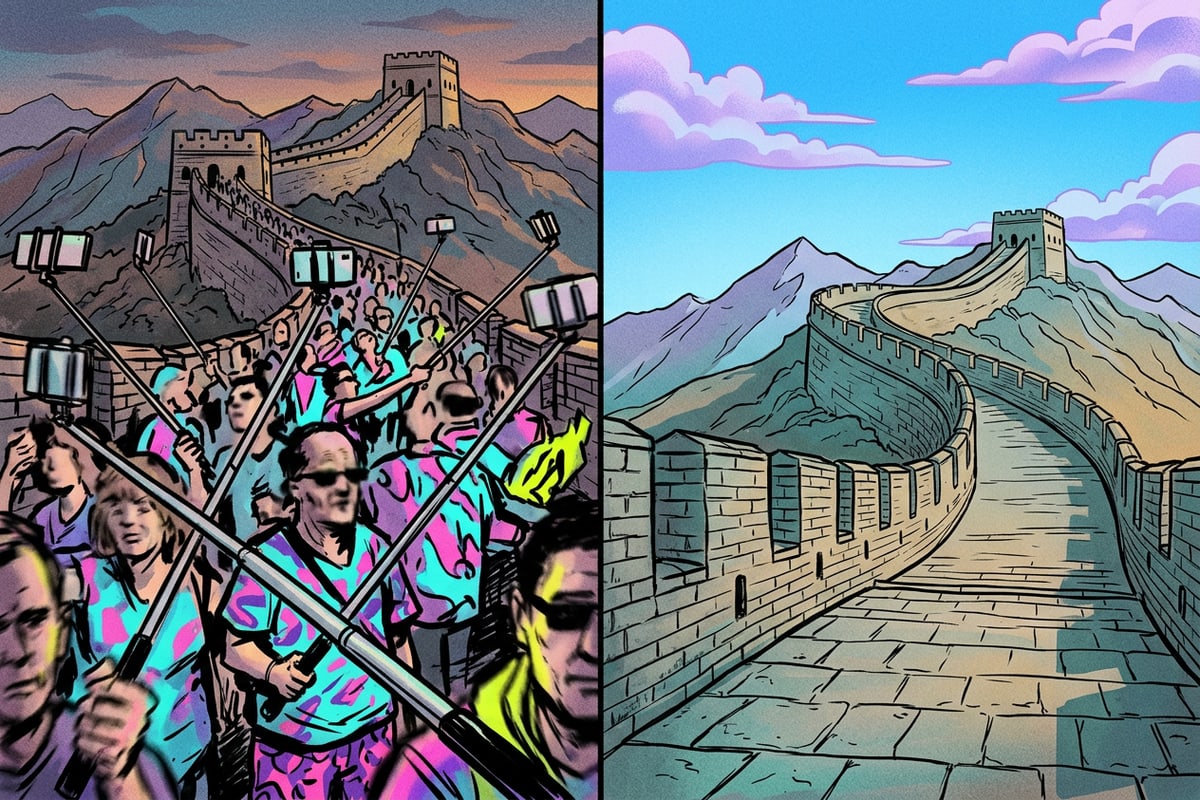
The 70/30 Rule: Keeping Your Memories Authentic
Address the ethics and psychology of photo editing in the AI era.
As AI object removal becomes a ubiquitous utility, a fascinating new psychological framework has emerged among everyday travelers: the 70/30 Rule of digital authenticity. In the early days of generative media, there was widespread concern that AI would completely erode the documentary truth of personal photography. However, recent public opinion data and behavioral analysis reveal a much more nuanced reality.[6]
The 70/30 Rule dictates that users want to maintain thirty percent authentic proof by keeping their own physical appearance, including flaws and fatigue, entirely untouched. Simultaneously, they are utilizing AI to apply seventy percent polish by completely sanitizing the background noise of the environment. High adoption rates for background removal tools contrast sharply with the rejection of AI-generated faces or artificial beautification.[7]
Travelers want to remember exactly how they looked in that moment, but they want to remember the location as they felt it, serene and majestic, rather than chaotic and congested. This behavioral split highlights a critical mandate for software developers: AI tools must focus heavily on sophisticated background reconstruction while strictly avoiding the unprompted beautification of the primary subject.
Navigating Semantic-Spatial Friction
Explain the limitations of AI when dealing with complex, overlapping crowds.
Despite the rapid advancements in generative media, conversational AI is not magic, and natural language remains an inherently imperfect tool for describing complex spatial relationships. When a user is faced with a highly cluttered scene, such as dozens of tourists overlapping with the intricate stone carvings of a historic cathedral, vision-language models can experience a phenomenon known as semantic-spatial friction.[10]
This friction occurs because text prompts often lack the geometric precision required to separate a foreground subject from a dense, layered background. Consequently, pure text-based agents might occasionally drift during the editing process. A prompt like 'remove the crowd' might result in the AI accidentally removing a structural pillar, blending a tourist's brightly colored jacket into the landmark's facade, or leaving behind phantom artifacts where people used to stand.[12]
Because of this semantic-spatial disconnect, complex backgrounds almost always require multiple attempts and iterative prompting. Understanding this technical limitation is crucial for setting realistic expectations: AI object removal is an iterative, conversational process, not a flawless one-shot guarantee. Users must be prepared to converse with the AI, refining their requests until the digital wipe achieves the desired level of cleanliness.
Step-by-Step: How to Clean Your Photos with CARA Agent
Provide a practical workflow using the CARA app's specific capabilities.
For travelers looking to apply the Empty Landmark hack, the CARA app on iOS and iPadOS offers a streamlined approach through its Conversational Photo Editing feature. By utilizing the CARA Agent, you can bypass complex interfaces and simply chat with the AI to refine your image. This completely removes the need for manual masking or technical knowledge.
Because the app relies on cloud processing to handle the heavy lifting, an internet connection is required, and results can vary based on the complexity of the original photo. The AI Eraser is designed to remove selected unwanted objects with AI assistance, but as noted with semantic-spatial friction, highly layered crowds may require a bit of patience. Here is how to execute the digital wipe effectively.
- Upload to the Agent
Open the CARA app and upload your crowded travel photo directly into the Agent chat interface.
- Issue a Natural Language Request
Type a clear instruction, such as 'Remove all the people in the background' or 'Erase the tourists behind me.'
- Review and Iterate
Evaluate the AI Eraser's output. If the background was highly complex and artifacts remain, simply ask the Agent to try again or specify the remaining objects to remove.
Image Extension: When the Crowd Crops the Landmark
Explain how to use Image Extender to rebuild borders cropped out by physical crowds.
Sometimes, the physical chaos of overtourism forces you to frame a shot so tightly that you cut off the top of a monument or the edge of a scenic vista just to avoid capturing a massive tour group. Removing the people is only half the battle; the other half is restoring the composition of the photograph so the landmark doesn't feel claustrophobic.
In these scenarios, CARA's Image Extender capability can be used to expand the image beyond its original borders. The AI generates surrounding content to give the landmark room to breathe and restores the aesthetic balance of the photograph. It is important to note that the generated edge content is an AI estimation and may differ slightly from the original physical scene, but it effectively rescues a poorly framed memory.
The Future of Memory Preservation
Conclude on the shifting burden from physical to digital spaces.
As we navigate the realities of travel in 2026, the definition of a real photograph is evolving. The friction between enterprise anxiety over AI compliance and consumer enthusiasm for memory curation has largely been settled in the consumer's favor. While enterprises fear the black box nature of generative models, everyday users view AI not as a deceptive tool, but as a necessary utility to filter out the noise of the modern world.[6]
By shifting the burden of crowd management from physical municipal domains to digital post-production, conversational AI allows us to reclaim the serenity of our travel experiences. The Empty Landmark hack isn't about rewriting history; it's about preserving the emotional truth of how a place felt, long after the crowds have faded into the background.[11]