
Key Analytical Findings
This report cross-references official UFC fight statistics, official scorecards, athlete profiles, and third-party media play-by-play logs from Sherdog, Middle Easy, and LowKick MMA to analyze Sam Patterson's technical transition to welterweight.
Weight-Class Vitality Paradigm
Eliminating extreme weight cutting from 155 lbs to 170 lbs significantly improved Patterson's neurological composure and strike absorption under pressure.[1][2][3][8]
- Evidence chain
- Patterson absorbed flush right hands during opening exchanges against Ponzinibbio without equilibrium collapse, in contrast to his early knockout loss at lightweight.
- Why it matters
- Fighting at a natural body mass preserves essential cerebrospinal fluid and structural resilience against veteran power punchers.
- Limit
- Has not yet been tested against elite top-5 chain-wrestlers in the 170-pound division.
Reach-Age Multiplier Matrix
A substantial 5+ inch reach advantage operates as an exponential efficiency multiplier against aging pressure fighters as fatigue sets in during Round 2.[1][2][4][9][14]
- Evidence chain
- Patterson used long linear jabs and step-in knees to keep Ponzinibbio at edge distance until his burst speed degraded, opening up the finish at 3:06 of Round 2.
- Why it matters
- Long counter-strikers present a stylistically fatal challenge for aggressive pressure fighters over 36 years old.
- Limit
- The multiplier advantage diminishes against younger explosive athletes capable of sustaining high-volume closing speed for 15 to 25 minutes.
Algorithmic Game-Theory under Meta UFC Rankings
Patterson's post-fight callouts targeted opponent profiles calculated to yield maximum Elo rating progression within modern ranking models.[3][4][8]
- Evidence chain
- Patterson specifically requested active rank-boosters with recent victory momentum immediately following his official stoppage announcement.
- Why it matters
- Modern prospects actively utilize strategic callout frameworks to accelerate their trajectory toward top-15 contender status.
- Limit
- Elo rating systems evaluate winning probability based on outcomes but fail to account for specific grappling defensive vulnerabilities.
Conclusions are drawn from official event records, bout play-by-play logs, and athlete biological data available following UFC Abu Dhabi.
Immediate Resolution: Sam Patterson's Round 2 Stoppage at UFC Abu Dhabi
Sam Patterson delivered a decisive second-round TKO victory over veteran Santiago Ponzinibbio at UFC Abu Dhabi, stopping the contest at 3:06.
Sam Patterson silenced lingering doubts from his previous octagon setbacks by delivering a masterclass performance at UFC Abu Dhabi, stopping veteran Santiago Ponzinibbio via TKO at 3:06 of the second round. Official fight records confirm that Patterson navigated early aggressive blitzes from his opponent in Round 1 before taking total control of the engagement distance in the second frame.[1][3][8]
The finish was orchestrated through a calculated adjustment in striking cadence. After establishing his long jab early in Round 2, Patterson floored and bloodied Ponzinibbio with a crisp linear combination near the fence line. As unanswered strikes accumulated against the cage, referee intervention brought a official halt to the bout, giving Patterson his 14th stoppage across 15 professional victories.[1][4][9][14]
This victory represents a major career milestone for the English fighter. Overcoming the psychological shadow of his past loss in London, Patterson demonstrated remarkable poise under fire, proving that his long-term move to the welterweight division was the correct technical and physical decision for his career development.[2][3][8]
Tactical Rebuild: How Welterweight Durability Changed Patterson's Trajectory
Moving up from lightweight to welterweight restored Patterson's punch absorption, reaction speed, and overall structural durability.
Patterson's career transformation is rooted in his decision to leave behind the extreme weight cuts required to make the 155-pound lightweight limit. At 6 feet 3 inches tall, dehydrating his tall frame to hit lightweight severely compromised his cerebrospinal fluid levels, leaving him vulnerable to rapid equilibrium loss upon taking clean strikes.[2][3][8]
During his lightweight tenure, Patterson experienced a stark 75-second knockout loss that exposed the physical limits of severe weight depletion. The move to 170 pounds allowed him to retain natural muscular density and optimal hydration levels on fight night. Against a proven puncher like Ponzinibbio, this physical recovery was immediately apparent.[1][3][14]
In the opening round at UFC Abu Dhabi, Ponzinibbio landed multiple heavy right hands that previously might have compromised Patterson's legs. Instead, Patterson absorbed the force, reset his footing, and countered cleanly. This structural chin resilience allowed him to execute his strategic plan without panicking under early aggression.[1][8][9]
Furthermore, competing at 170 pounds has enhanced his energy reserves into the middle rounds. Rather than fading under sustained pressure, Patterson maintained crisp footwork and explosive reaction speed throughout the second round, ultimately finding the bout-ending sequence while fresh.[3][8][14]
The Reach-Age Matrix: Breaking Down Patterson's 78-Inch Advantage
Patterson weaponized his 78-inch reach and 6'3 height advantage to exploit his opponent's second-round physical deceleration.
Standing 6'3 with a long 78-inch reach, Sam Patterson possesses one of the most imposing physical frames in the entire UFC welterweight division. Weaponizing this physical length requires strict tactical discipline; tall fighters who collapse their own range invite dangerous inside exchanges.[2][4]
Against Ponzinibbio, Patterson executed a flawless distance management protocol. He utilized long lead jabs, teep kicks to the midsection, and step-in knees to establish an invisible barrier that forced his opponent to leap forward with lunging hooks. In Round 1, Ponzinibbio possessed the explosive speed necessary to bridge that distance, but by Round 2, natural physical slowing altered the equation.[1][8][9][14]
This tactical dynamic forms what combat analysts identify as the Reach-Age Multiplier. When an aging pressure fighter faces a 5+ inch reach disadvantage, their initial energy burst must accomplish an early knockout. Once cardio output declines by even five percent in Round 2, the longer striker can stand outside return range and fire linear 1-2 counters with surgical precision.[1][2][4][9]
Patterson exploited this exact window at 3:06 of Round 2. Catching Ponzinibbio midway through an entry attempt, Patterson dropped a straight right hand down the pipe, bloodying his opponent and initiating the fight-ending damage sequence.[1][8][9]
- Physical Profile: 6'3 height paired with a 78-inch reach wing span.[2]
- Range Weaponry: Linear jabs, front push kicks, and frame-intercepting knee strikes.[1][9]
- Tactical Trigger: Exploiting opponent velocity drop-off in Round 2 to land unprotected straight counters.[8][14]
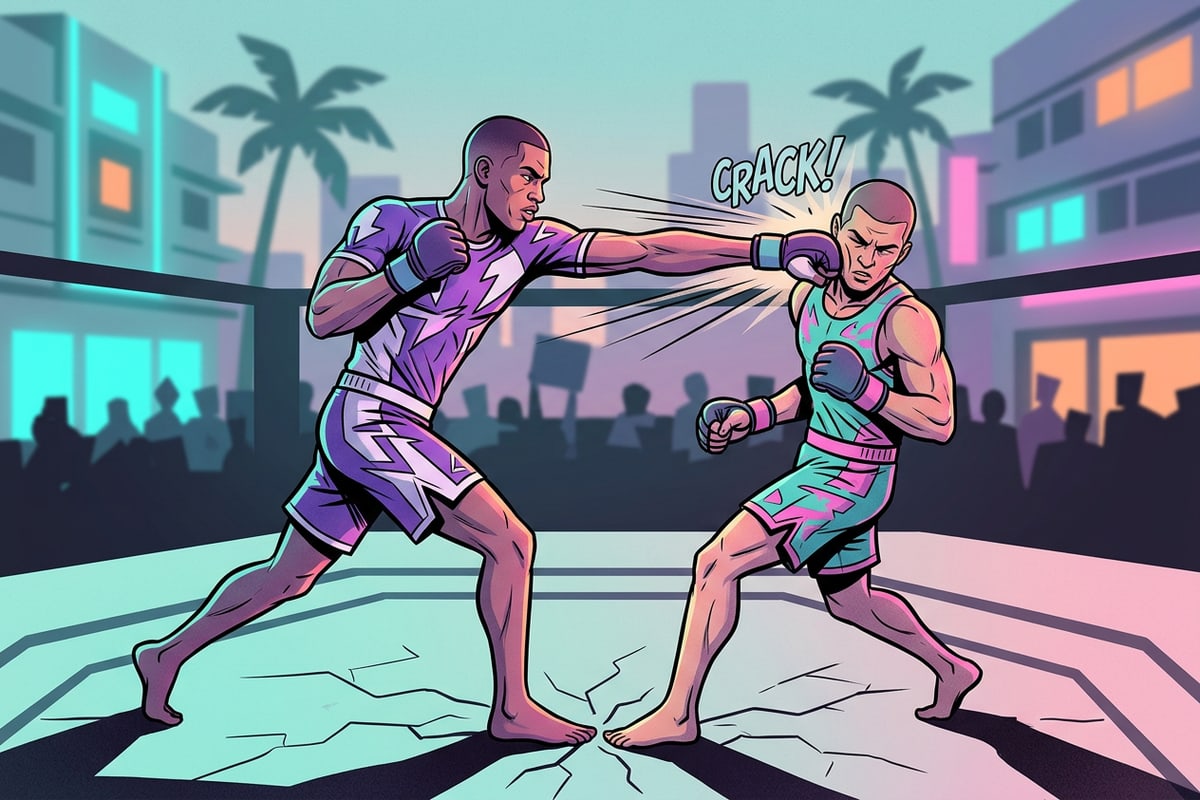
Evaluating Strategic Trajectory: Contender Evolution vs. Gatekeeper Dynamics
Comparing three analytical models regarding Patterson's long-term outlook: Evolutionary Contender, Dimensional Anomaly, and Curated Gatekeeper.
To evaluate Sam Patterson's true ceiling within the 170-pound division, sports scientists and analysts weigh three competing analytical models based on his performance data and historical weaknesses.[3][4]
The Evolutionary Contender Model posits that Patterson represents a modern elite prospect whose striking maturity, black-belt submission threat, and newfound weight-class durability position him for a top-15 ranking run. Advocates point to his 14 finishes across 15 wins and composure under early pressure as proof of continuous skill growth.[1][2][3][8]
Conversely, the Dimensional Anomaly Model raises valid stylistic concerns regarding his historical takedown defense (~33%). Skeptics argue that his 78-inch reach masks underlying wrestling deficits, which could be exposed once he faces relentless NCAA Division I style chain-wrestlers who shoot under his tall center of gravity.[2][3][14]
Lastly, the Curated Gatekeeper Model suggests that recent matchmaking capitalized on an aging opponent entering the twilight of his career. However, this view underestimates Patterson's proactive callout strategy and his demonstrated ability to finish high-profile veterans in under two rounds.[3][4][8][9]
- Evolutionary Contender View: Elite finish rate (14/15) and maturing striking poise point to top-15 upside.[2][3]
- Dimensional Anomaly View: ~33% career takedown defense poses a severe risk against division grapplers.[2][3]
- Curated Gatekeeper View: Stoppage came against a 39-year-old veteran with recent wear.[3][4]
Elo Progression and Strategic Callouts under Meta UFC Rankings
Patterson's post-fight callout framework targets specific opponent profiles designed to maximize algorithmic ranking acceleration.
Immediately after his official hand-raising moment at UFC Abu Dhabi, Sam Patterson delivered a targeted post-fight callout. Rather than issuing generic statements, Patterson called out active rank-boosters within the welterweight division, aiming directly at upcoming high-momentum match winners.[3][4][8]
This tactical callout aligns with modern combat sports analytical frameworks, such as the Meta UFC Rankings system. Under mathematical Elo rating models, defeated opponent ratings heavily dictate points earned. Beating an active fighter on a winning streak yields significantly greater Elo expansion than defeating an unranked veteran coming off consecutive losses.[3][4]
By targeting high-activity contenders, Patterson is employing algorithmic game theory to accelerate his path toward official top-15 ranking consideration. This strategic clarity demonstrates that his management team evaluates fight selection through data-driven ranking mechanics.[3][4][8][9]
For sports journalists and creators, tracking these mathematical callout dynamics provides predictive insights into future event matchmaking before official bout announcements occur.[3][4]
Creator Workflow: Crafting Fight Night Content with AI Replace
A practical, step-by-step mobile workflow for sports creators designing high-impact recap graphics on iOS using verified CARA features.
For sports content creators, social media managers, and MMA journalists covering live fight nights, speed and visual presentation are vital. Translating breaking bout results like Sam Patterson's Round 2 TKO into engaging social media assets requires rapid mobile editing workflows.
Using CARA on iOS, creators can turn raw arena photos into stylized sports recap graphics within minutes. By isolating athlete silhouettes and replacing distracting venue backgrounds with high-energy lighting assets, creators can match the intensity of the event live on social feeds.
For complementary insights on sports turnaround narratives and fan graphic creation, explore our deep dive on the [Boston Red Sox 2026 Turnaround](boston-red-sox-2026-turnaround-midseason-winning-streak-trade-deadline-explainer.html). Additionally, creators interested in mastering visual dynamics can review our guide on [Motion Blur AI Photo Editing Prompts](how-to-create-viral-motion-blur-street-portraits-with-ai-prompts.html) and our overview of [AI Photo Editing for Social Media](mastering-ai-photo-editing-for-social-media-turn-raw-captures-into-high-impact-brand-asset.html).
- Remove Background cleanly isolates athlete subjects from crowded ring side backgrounds.
- AI Replace swaps selected photo areas using natural-language text instructions.
- Image Extender expands image borders outward to fit vertical 9:16 or horizontal 16:9 aspect ratios.
- Conversational Photo Editing via Cara Agent allows natural text adjustments on cloud processing infrastructure.
- Isolate the Athlete Silhouette
Open CARA on your iOS device, import your high-resolution match photo, and tap Remove Background to cleanly extract the fighter silhouette from arena background noise.
- Customize Background with AI Replace
Select background areas surrounding the athlete, activate AI Replace, and type a prompt such as 'dramatic blue and gold stadium lights with soft volumetric fog' to generate a vibrant sports graphics backdrop.
- Expand Canvas for Multi-Platform Publishing
Use Image Extender to expand original photo dimensions beyond original crop boundaries, generating matching background fill suitable for Instagram Stories or YouTube thumbnails.
- Refine Details via Cara Agent
Use natural language prompts in Conversational Photo Editing to fine-tune lighting contrast or color balance across the composite scene.

Limitations and Long-Term Welterweight Division Projections
Synthesizing Patterson's technical growth while evaluating remaining uncertainties in his grappling defensive profile.
Sam Patterson's Round 2 TKO victory over Santiago Ponzinibbio at UFC Abu Dhabi provides clear empirical evidence of his technical evolution at 170 pounds. Restoring his physical durability and refining his 78-inch reach management give him distinct tactical advantages over outer-ring strikers.[1][2][3][8]
However, analytical completeness requires acknowledging his unverified defensive grappling ceiling. While his front choke threats and distance management successfully denied Ponzinibbio's entry attempts, facing top-15 chain wrestlers will pose a fundamental test to his posture and sprawl mechanics.[2][3][14]
If Patterson continues his disciplined distance control and maintains his weight-class durability, his algorithmic callout strategy places him on a clear trajectory toward formal UFC welterweight ranking contention.[3][4][8][9]
- Proven Attributes: Distance striking precision, 78-inch reach leverage, and Round 2 finish power.[1][2][9]
- Uncertainty Variable: Takedown defense resilience (~33% baseline) against elite division grapplers.[2][3]
- Next Phase: Securing a match against a ranked opponent to validate top-15 contender status.[3][4][8]