
The Art of Subtraction: Why Clean Photos Look Professional
Establish the creative need for object removal and introduce the concept of visual weight.
Professional photography is often described as the art of subtraction. While amateurs try to fit as much as possible into a single frame, professionals actively look for elements to remove. Every stray coffee cup, bright background sign, or photobomber carries visual weight, pulling the viewer's eye away from your intended subject. When a photograph is cluttered with these unintended focal points, the overall composition suffers because the viewer does not intuitively know where to look [S2].[2]
By mastering the art of subtraction, you can guide the viewer's attention exactly where you want it, instantly elevating the perceived quality of your image. Historically, cleaning up these visual distractions required meticulous manual cloning, a process that demanded significant technical skill and often took upwards of ten minutes of tedious pixel-matching to align lighting, shadows, and depth. Modern AI inpainting has completely shifted this paradigm for mobile creators [S2].[2]
Because AI interprets scene context like lighting and depth, it can reconstruct backgrounds naturally in just seconds, allowing you to focus entirely on the creative strategy of subtraction rather than the technical labor of pixel manipulation. This rapid transformation democratizes high-end photo editing, giving everyone the power to produce clean, professional-grade images without needing years of training in complex desktop software.
Step-by-Step: How to Use Cara's AI Eraser
Provide a clear, actionable tutorial for the core AI Eraser feature.
Cara's AI Eraser is designed to be highly intuitive, requiring zero prior photo editing experience to achieve stunning results. The tool leverages advanced generative models to analyze your image and seamlessly fill in the gaps left by removed objects. Because the heavy lifting is handled by cloud processing, you can focus entirely on selecting the right elements to remove. Keep in mind that each generation attempt costs 30 points, so it pays to be deliberate with your selections [S1].[1]
When you swipe your finger over a cluttered desk or a distracting street sign, the app processes the request rapidly. The resulting visual wipe is incredibly satisfying, revealing a clean, textured surface where the clutter used to be. This immediate feedback loop encourages creative experimentation, allowing you to quickly test different compositional ideas and refine your visual storytelling on the go.
- Navigate to the Tool
Open the Cara app on your iOS or iPadOS device. From the Home screen, tap on AI Editing, and then select Object Removal to launch the AI Eraser interface [S1].[1]
- Select the Unwanted Object
Use your finger to paint a mask over the element you want to remove. Ensure you cover the entire object, including any shadows or reflections it casts on the surrounding surfaces to maintain visual realism.
- Process the Image
Confirm your selection to let the AI process the removal. The app will analyze the surrounding pixels and generate a natural-looking replacement background for 30 points per use [S1].[1]
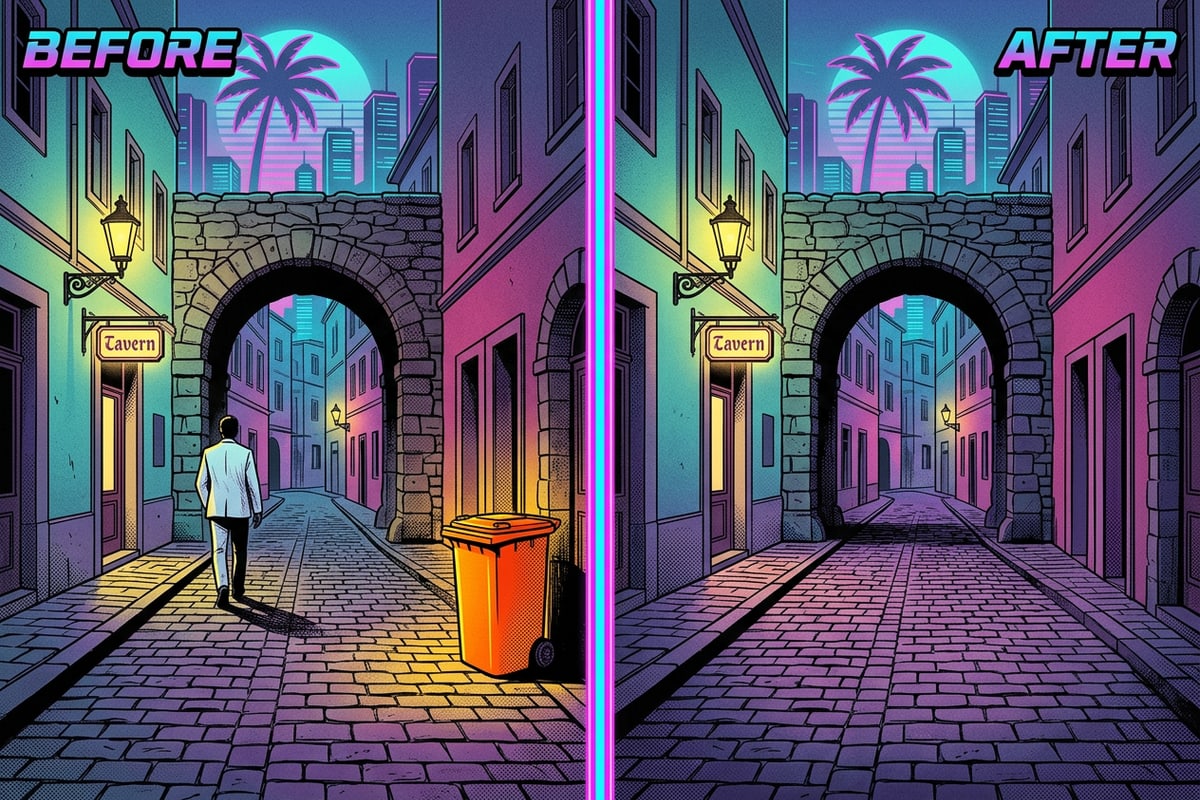
Pro Techniques: Handling Edge Tangencies and Complex Textures
Offer advanced compositional value and troubleshooting tips for difficult edits.
One of the most impactful compositional secrets you can apply is the elimination of edge tangencies. These are distracting elements that touch or intersect the very border of your photo's frame, such as a stray tree branch, half of a parked car, or a random pedestrian's arm. Because our eyes naturally scan the perimeter of an image to establish context, edge tangencies act as visual traps, pulling attention away from the center subject [S2]. Using the AI Eraser to clean up the borders of your photo provides a disproportionately high boost to its professional feel.[2]
While the AI Eraser works beautifully on simple, uniform backgrounds like clear skies or smooth walls, complex textures like dense foliage, brick walls, or patterned fabrics can sometimes require multiple attempts [S1]. If the first attempt looks slightly off or introduces strange artifacts, do not give up. Complex backgrounds may require another attempt, and the most effective strategy for these scenes is iterative inpainting [S1].[1]
AI models are significantly better at reconstructing small patches of texture than generating massive background replacements in a single pass. By taking a step-by-step approach, you give the AI model more surrounding context to work with for each small patch, resulting in a much more seamless blend [S2]. This methodical technique ensures that even the most challenging backgrounds can be reconstructed with high fidelity.[2]
- Instead of selecting a massive object all at once, remove it in smaller, overlapping bites to help the AI model process the texture more accurately [S2].[2]
- This step-by-step approach gives the AI model more surrounding context to work with for each small patch, leading to cleaner results [S2].[2]
- If a specific generation fails to blend well, simply undo the action and try selecting a slightly different area to guide the AI's reconstruction.
The Integrated Creative Flow: A User-Led Strategy
Show how to combine AI Eraser with other Cara features for a complete professional overhaul.
Removing a large object can sometimes leave your photo feeling unbalanced or empty. Professional editing isn't just about taking things away; it is about managing the overall visual harmony of the frame. To address this, we recommend a conceptual framework introduced by our editorial team known as the Integrated Creative Flow. It is important to note that this is a user-led strategy, not an official Cara feature name or a single button within the app. This workflow involves manually combining the AI Eraser with other generative tools for a complete professional overhaul.
Imagine you have a beautiful portrait taken on a busy street, and you use the AI Eraser to remove a large, distracting vehicle from the left side of the frame [S1]. While the vehicle is gone and the background is perfectly reconstructed, the visual weight of the image has now shifted entirely to the right. The subject feels cramped against the edge, and the composition feels lopsided. To fix this, you can manually transition from the AI Eraser to Cara's Image Extender [S1].[1]
By expanding the borders of the image, the Image Extender generates new surrounding content [S1]. Keep in mind that generated edge content may differ from the original scene [S1]. This visual transition is profound: you move from a state of subtraction to a state of expansion, restoring the necessary breathing room and re-centering your subject perfectly within the newly generated space. For more tips on balancing multi-dimensional layouts, check out our guide on [Advanced Photo Collage Techniques](beyond-the-grid-mastering-advanced-photo-collages-with-cara-ai.html).[1]
Furthermore, it is crucial to understand the distinction between AI Eraser and AI Replace. While AI Eraser removes an object and fills the space with a matching background, AI Replace allows you to swap a selected area with something entirely new using a text instruction [S1]. If erasing a subject leaves a noticeable void, you can use AI Replace to add a vintage lamp or a potted plant [S1]. Keep in mind that AI Replace results depend heavily on your specific text prompt [S1].[1]
Understanding the Points System and Success Guarantees
Provide transparency on pricing and the refund policy.
Because generative AI requires significant cloud computing power to reconstruct backgrounds realistically, Cara utilizes a transparent points system for its advanced editing tools. Each use of the AI Eraser costs 30 points per generation attempt [S1]. It is important to factor this into your editing workflow, especially when using the iterative, step-by-step removal technique on complex backgrounds, as each individual bite will consume points. To learn how to optimize your points usage, read our comprehensive [Cara AI Points Guide](cara-ai-points-system-a-transparent-guide-to-smart-editing-and-avoiding-wasted-credits.html).[1]
To ensure you only pay for actual results, Cara includes a built-in success guarantee. If the cloud processing fails to complete your object removal request due to a technical error, the app automatically refunds the points for that attempt [S1]. This risk-free approach encourages users to try removing difficult objects without the fear of wasting their balance on failed generations. For a complete breakdown of subscriptions and credit options, see our guide on [Cara AI Pricing](ai-photo-editor-pricing-how-cara-s-points-and-subscriptions-work-ko.html).[1]
Currently, these powerful AI editing features are available exclusively on the Cara app for iOS and iPadOS [S1]. This platform exclusivity ensures a highly optimized, stable, and responsive mobile experience. Please note that there is currently no Android app or Cara Web App available, so you will need an Apple device to access these tools.[1]