Key Analytical Findings
This report synthesizes Cara's App Store metadata, Banana Studio's official refund policies, and competitor dual-meter billing systems to analyze the variable cost dynamics of generative AI applications.
Daily Rewards as Economic Conditioning
Daily free points function as an economic conditioning tool rather than a traditional loss-leader.[4][5]
- Evidence chain
- By granting a daily allowance, the platform assigns psychological weight to points before a user ever reaches a paywall, familiarizing them with the compute-as-utility concept.
- Why it matters
- Users who exhaust their free points experience lower friction when purchasing pay-as-you-go packs because they already understand the currency's value.
- Limit
- If the daily allowance is too low to complete a single heavy task, it may cause immediate user abandonment rather than conversion.
Subscriptions as a Compute Hedge
Annual subscription tiers function as a financial hedge against API price volatility for both the developer and the user.[4][12]
- Evidence chain
- Upfront capital from annual subscriptions allows the developer to reserve bulk GPU instances, which in turn provides power users with a more stable and cost-effective point allocation.
- Why it matters
- For consistent creators, annual subscriptions offer the best effective cost per generation compared to reactive credit pack purchases.
- Limit
- This model requires high initial trust from the user regarding the long-term output quality of the AI models.
The Expectation Gap in Legacy SaaS Models
Users frequently expect premium subscription tiers to offer unlimited access, leading to friction in AI-driven applications.[2][10]
- Evidence chain
- Legacy SaaS models like video streaming have conditioned users to equate 'Pro' with 'Unlimited', whereas App Store descriptions for AI tools explicitly list credit packs alongside subscriptions to manage variable costs.
- Why it matters
- Clear editorial education and in-app cost disclosures are necessary to prevent accidental compute drain and subsequent refund requests.
- Limit
- Exact point-per-feature costs are dynamic and not always detailed in public metadata, requiring users to monitor their balance actively.
Pricing structures, point allocations, and refund policies are subject to change based on regional currency discrepancies, App Store policy updates, and underlying API cost fluctuations.
The Reality of AI Compute: Why Points Exist
Understanding the shift from local hardware processing to cloud-based utility computing.
For years, mobile photo editing relied on the processing power of the device in your hand. Applying a traditional color filter or cropping an image utilized your phone's local hardware, meaning developers could offer these tools for a flat fee or entirely for free. Generative AI has fundamentally broken this legacy model. When you ask an application to generate a new image from text or transform a video into a comic layout, your phone is not doing the heavy lifting. Instead, the application sends your request to massive, energy-intensive cloud servers equipped with specialized GPUs.[2][11]
This shift introduces what industry analysts call the variable cost crisis of generative AI. Every single prompt, edit, and generation incurs a tangible physical cost in server time and electricity. Cara's points system is a direct, transparent proxy for these physical server costs. Rather than hiding the expense or degrading the quality of the output to save money, the platform uses a hybridized monetization model. Points ensure that the infrastructure can support high-quality outputs like Conversational Photo Editing, which requires significant cloud processing to interpret natural language requests.[2][6]
Points vs. Subscriptions: Choosing Your Creative Path
Breaking down the three primary ways to access Cara's features based on user behavior.
Navigating Cara pricing requires understanding that access is not one-size-fits-all. The platform offers three distinct paths tailored to different types of creators. First, the daily free point mechanics provide a baseline allowance. This allows casual users to experiment with lighter tools or save up for a single complex generation without upfront investment. However, for users who want to create without waiting for daily resets, Cara offers Pay-As-You-Go credit packs. These packs, available in increments from 5,000 to 20,000 units, are ideal for project-based creators who need a sudden burst of compute power for a specific campaign or event.[1][4]
For consistent users, Cara provides annual subscription tiers: Plus Yearly at $29.99 and Pro Yearly at $59.99. It is crucial to understand that these subscriptions do not offer unlimited AI generations for a flat fee. Instead, they provide a higher daily quota of points and a more cost-effective baseline for power users. By securing upfront capital, the developer can reserve bulk cloud compute, passing the efficiency savings on to subscribers. Choosing between these paths depends entirely on whether your creative output is sporadic or sustained.[1][5]
The 'Heavy Lifting' Menu: Mapping Feature Costs
Educating users on which features consume points faster due to their computational intensity.
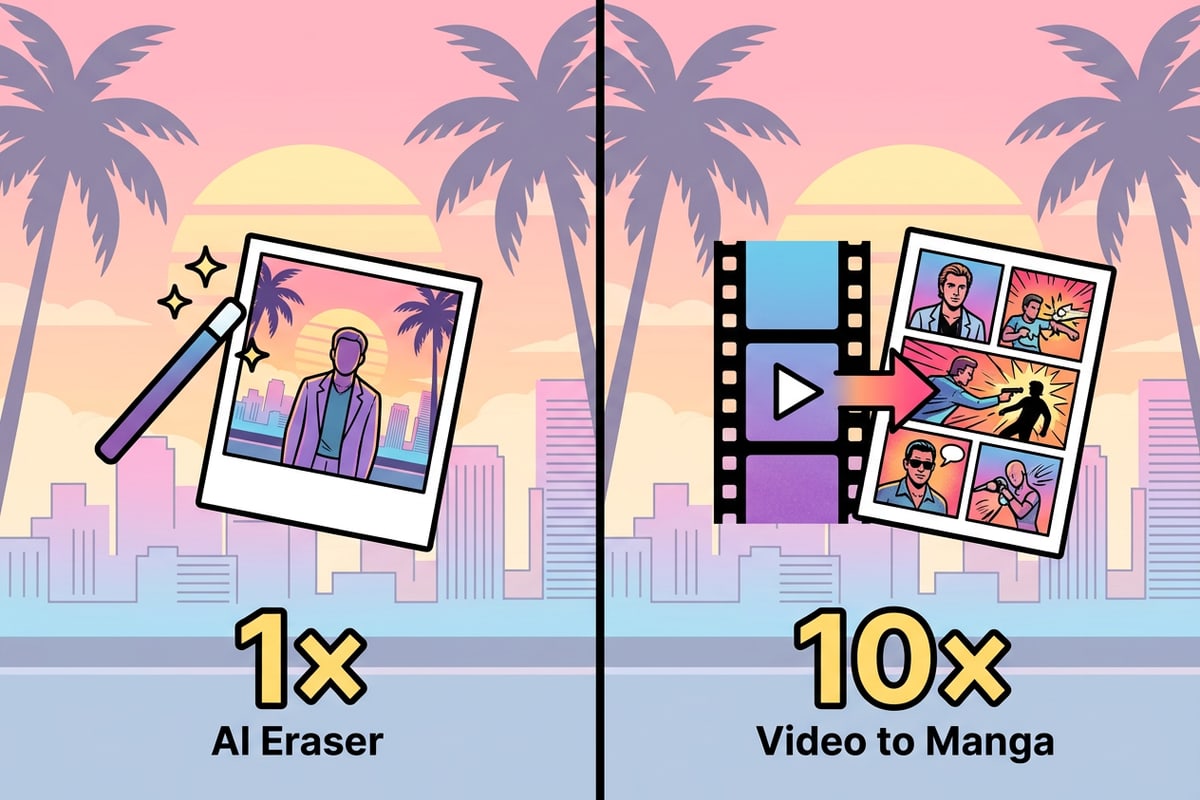
Not all AI features are created equal. The computational weight of a task dictates its point cost, creating a spectrum from light edits to heavy generative lifting. For example, using the AI Eraser to remove a small object from a background requires relatively low compute power. While complex backgrounds may require another attempt, the overall point drain is minimal. Similarly, tools like Remove Background or basic Photo Colorize operate on established, efficient models that do not heavily tax the user's point balance.
Conversely, heavy tasks require significantly more points. Text-to-Image generation costs and times depend heavily on the selected model and resolution. Generating a highly detailed 4K image using a premium model will consume a large portion of a daily allowance. The most computationally intense features involve video. Video to Manga, which turns a supported video clip into comic-style pages using selected key moments, requires analyzing multiple frames and generating complex layouts. Because this is a specialized tool rather than a general-purpose video editor, the point cost reflects the massive cloud processing required to deliver the final manga page.[1]
Managing Your Balance and Avoiding Bill Shock
Transparency on refund policies and tips for sustainable usage.
The most common source of frustration in AI applications is accidental compute drain, where users rapidly exhaust their points on heavy tasks without realizing the cost. To avoid bill shock, users must actively monitor the pre-generation cost disclosures within the Cara interface. Because points represent actual server time that has already been spent, Banana Studio's official policy states that consumed digital credits are strictly non-refundable. Once the cloud GPU has processed your request, that energy and time cannot be returned.[2][3]
While there is a standard 24-hour refund window for certain in-app purchases, this generally applies to the subscription itself or unspent credit packs, subject to Apple's overarching App Store policies. If you purchase a 20,000-unit credit pack and immediately spend 15,000 points generating high-resolution Text-to-Image variations, you cannot refund the consumed portion. Sustainable usage requires treating your point balance like a creative battery: plan your heavy generations, use light tools for minor corrections, and always review the estimated cost before tapping generate.[3][7][12]
- Check the Estimate
Always look at the point cost displayed on the generation button before confirming your request.
- Start Small
When testing a new text prompt, generate a lower-resolution image first to ensure the composition is correct before spending points on a 4K upscale.
- Understand the Refund Limits
Remember that consumed points cannot be refunded, even within the 24-hour purchase window.[3]
The Variable Cost Crisis in Generative AI
Deep dive into the industry context of AI pricing models.
To truly understand why Cara prices its features the way it does, it is helpful to look at the broader app ecosystem. The app marketing and monetization landscape has been upended by the variable cost crisis. Traditional software development involved high fixed costs to build the app, followed by near-zero marginal costs to distribute it to millions of users. Generative AI flips this equation. The marginal cost of every single user interaction is greater than zero because it requires renting time on advanced cloud infrastructure.[2][8]
Competitors across the AI photo editing space have struggled with this reality, often launching with unlimited flat-fee subscriptions only to quietly introduce strict quotas later when server bills become unsustainable. Cara's approach of using a dual-meter system—combining base subscriptions with top-up credit packs—is a transparent response to this crisis. It prevents a small percentage of extreme power users from bankrupting the system, ensuring that the platform remains stable and responsive for the rest of the user base.[4][5][9]
Optimizing Conversational Photo Editing Costs
How to efficiently use Cara's Agent experience without wasting points.
Conversational Photo Editing is one of Cara's standout features, allowing users to edit or generate images through natural-language requests. However, because it relies on complex language models to interpret your intent before triggering the image generation models, it carries a specific computational weight. Cloud processing is required for every interaction, and results can vary based on how clearly you phrase your request.
To optimize your point usage in the Agent experience, be as specific as possible in your initial prompt. Vague requests often lead to multiple revisions, with each revision consuming additional points. If you want to use the Image Extender to expand a photo beyond its original borders, specify exactly what kind of surrounding content you expect. While generated edge content may differ from the original scene, a precise prompt reduces the likelihood of needing a costly redo.
The Psychology of Daily Allowances
How daily free points condition users to understand the value of compute.
The inclusion of daily free points is not merely a generous gesture; it is a vital educational tool. By granting users a daily allowance, Cara introduces the concept of compute-as-utility. Users quickly learn that AI generation is a finite resource. This economic conditioning is essential for building long-term trust. When a user eventually encounters a paywall or decides to purchase a credit pack, they already understand the inherent value of the points they are buying.[4][5]
This system also encourages deliberate creativity. When users know they have a limited daily budget, they spend more time refining their ideas and prompts rather than mindlessly tapping the generate button. This friction actually leads to higher quality outputs and a deeper appreciation for the technology powering features like AI Replace, where the final result depends heavily on the quality of the user's initial selection and prompt.[4][11]
Strategic Framework: Maximizing Your Cara Investment
A decision framework for choosing the right monetization path.
Choosing the right way to pay for Cara comes down to mapping your creative ambitions against the reality of cloud compute costs. If your primary goal is to occasionally remove a background or use the AI Eraser on a weekend photo, the daily free points are likely sufficient. The friction of waiting for a daily reset is a fair trade-off for zero financial cost.[1]
However, if you are planning to create a series of cinematic match day graphics or transform multiple video clips into manga pages, relying on daily points will stall your workflow. In these scenarios, purchasing a 10,000-unit credit pack provides the necessary compute burst. Finally, if you are a daily creator who relies on Text-to-Image generation for social media content, the Pro Yearly subscription offers the most sustainable point quota, acting as a reliable hedge against the variable costs of high-end AI models.[1][4]