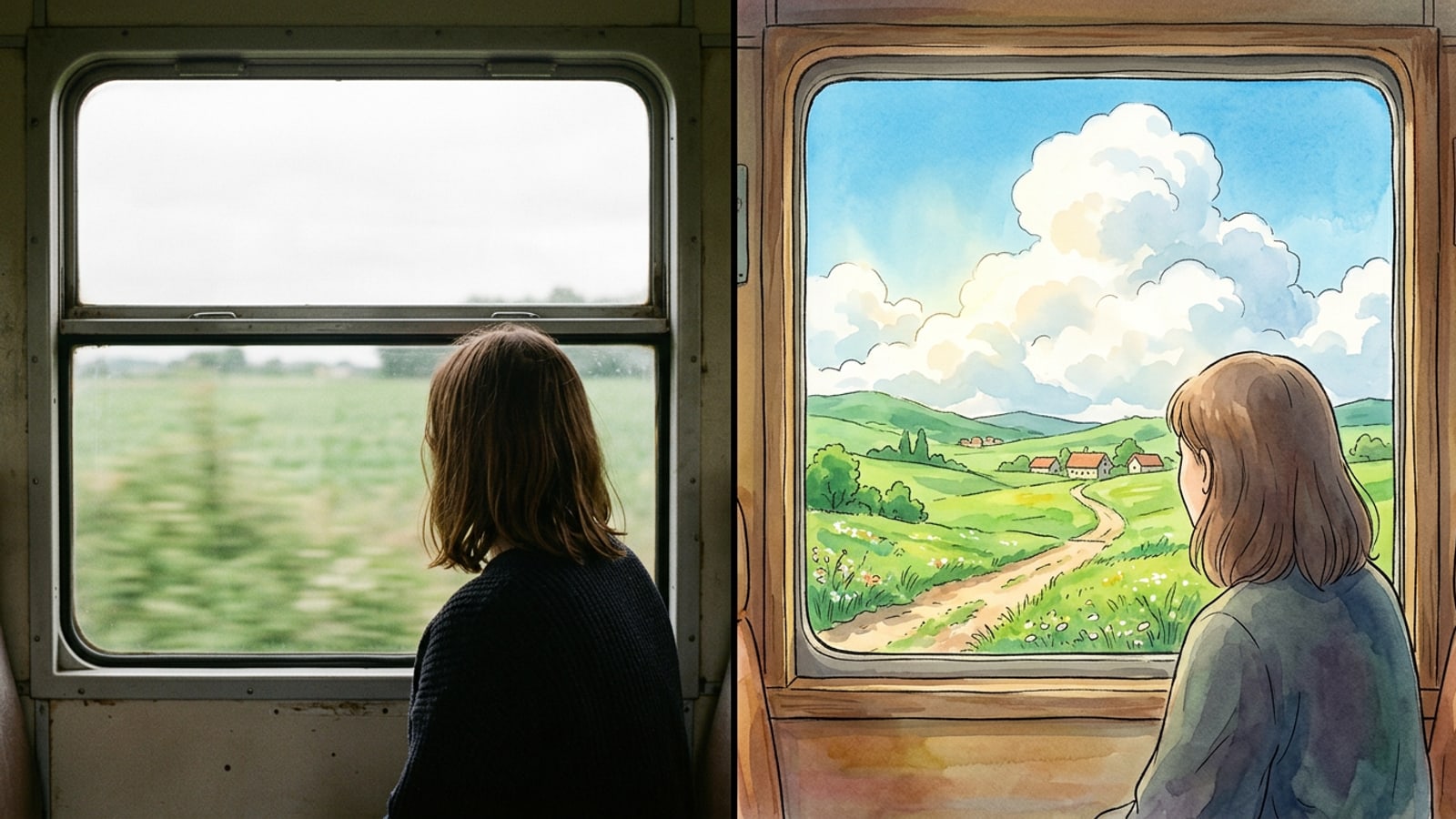
Key Analytical Findings
This report synthesizes temporal consistency benchmarks, cultural adoption metrics, and platform data across global markets to evaluate the technical and cultural drivers of the AI anime trend.
The Temporal Consistency Masking Effect
Watercolor textures allow the human brain to interpret technical flickering as intentional, hand-painted motion.[6][7][8]
- Evidence chain
- Photorealistic models trigger the uncanny valley when faces warp, while watercolor clouds shifting geometry are interpreted as stylistic choices.
- Why it matters
- Non-photorealistic styles will consistently outperform realistic styles in viewer retention until models reach near-perfect stability scores.
- Limit
- As physics engines in AI models improve, the mechanical necessity of the anime mask will decline.
Inverse Relationship of Cultural Proximity
Willingness to commoditize AI aesthetics scales inversely with a market's ownership of the original intellectual property.[4][9]
- Evidence chain
- Consumer markets with low native anime industries show aggressive adoption, whereas origin markets demonstrate significant professional fear and studio backlash.
- Why it matters
- Brands and creators see high engagement in the Middle East and the Americas, while risking reputational damage in origin markets.
- Limit
- Pending intellectual property litigation regarding artistic style could neutralize this geopolitical arbitrage.
The Bimodal Animation Economy
AI has polarized the visual economy into high-volume automated content and human-crafted luxury goods.[10][13][14]
- Evidence chain
- The barrier to entry for basic animation has plummeted, prompting luxury houses to use human-crafted anime to signal status and authenticity.
- Why it matters
- Human animation has transitioned from a standard production method to a luxury commodity.
- Limit
- This dynamic assumes audiences can continue to distinguish between high-end AI and human craft.
Pending intellectual property litigation, environmental compute constraints, and rapid advancements in physics engines for AI video generation may alter the technical necessity and legal viability of these stylistic masks.
The 155M Post Phenomenon: Why Ghiblification is Dominating 2026
Exploring the massive scale of the anime video trend on social media platforms and the psychological drivers behind its viral success.
The sustained global virality of the Ghiblification trend is not just a fleeting cultural moment; it is a functional byproduct of current technological limitations meeting an insatiable demand for content. As social platforms continue to expand their footprint, the competition for human attention has reached unprecedented levels. Major networks have now reached 1.9 billion monthly active users, with average daily usage hitting between 52 and 58 minutes per adult user.[1]
This massive scale of daily consumption has culminated in a digital landscape that demands constant visual novelty. To stand out in a feed of endless scrolling, creators are turning to stylized content that immediately arrests the eye. Ghibli-style AI video transformations now account for over 155 million videos on social media, contributing to a broader ecosystem where 71 percent of social media images now feature some form of AI element.[2]
Beyond the sheer numbers, the trend taps into a deep psychological desire for pastoral, nostalgic escapes. Often referred to as the 'Iyashikei' or healing aesthetic, the soft watercolor skies, lush green landscapes, and gentle pacing of these videos offer a stark contrast to the hyper-stimulating, fast-paced nature of modern digital life. By transforming mundane reality into a romanticized, hand-drawn fantasy, creators are providing their audiences with micro-doses of visual therapy.
However, the dominance of this specific aesthetic is not merely a matter of artistic preference. As we peel back the layers of the trend, it becomes evident that the Ghibli Summer is actually a highly effective technical workaround. The style serves as a necessary bridge, allowing creators to utilize generative video technology while completely bypassing the glaring flaws that currently plague photorealistic AI models.
The Science of the Mask: Why Anime Styles Outperform Realism
An in-depth look at how watercolor aesthetics hide AI video artifacts, improve viewer retention, and bypass the uncanny valley.
The secret behind the overwhelming success of the Ghibli Summer trend lies in how the human brain processes visual imperfections, specifically through a phenomenon known as the Temporal Consistency Masking Effect. In the realm of generative video, maintaining the exact shape, texture, and identity of an object from one frame to the next is incredibly difficult. Industry standard scene stability scorecards heavily weigh geometric persistence and background lock ratings when evaluating AI video quality.[3]
When a photorealistic AI video suffers from poor geometric persistence, the results are deeply unsettling. A human face that slightly melts or a building that shifts its architectural structure immediately triggers the uncanny valley effect. The viewer's brain recognizes that something is fundamentally wrong with the physics of the scene, causing them to experience revulsion and immediately scroll past the video.[7][8]
The Temporal Consistency Masking Effect completely changes this dynamic by altering the viewer's baseline expectations. Soft watercolor textures, impressionistic backgrounds, and hand-drawn line art inherently lack strict geometric rigidity. When an AI model struggles to maintain the exact shape of a cloud or the precise folds of a shirt in an anime style, the brain does not register it as a technical failure.[6]
Instead, the human eye interprets this technical flickering as intentional, artistic motion. The shifting geometry is forgiven as the natural 'boiling' effect often seen in traditional hand-painted animation. By applying this non-photorealistic mask, creators can utilize AI video generation tools that would otherwise be deemed too unstable for public consumption, effectively turning algorithmic flaws into stylistic features.[6][7]
Economic Arbitrage in Digital Animation
Analyzing the massive cost reduction driving creator adoption of AI anime styles and the democratization of high-end aesthetics.
Beyond the technical masking benefits, the rapid shift toward AI-generated anime is driven by pure economic arbitrage. Historically, traditional animation has been a highly labor-intensive process that commands premium pricing. This high barrier to entry made cinematic, hand-drawn aesthetics completely inaccessible for the average travel vlogger, independent creator, or mid-tier digital marketing agency.
The introduction of Video-2-Comic AI tools has fundamentally disrupted this economic model. The cost delta between human-crafted animation and generative output is staggering. Traditional anime production costs approximately $8,333 per minute of finished footage. In stark contrast, AI-generated anime drops that cost to roughly $175 per minute.[5]
This represents a 97.9 percent reduction in production expenses. For a content creator looking to monetize a summer travel vlog, this cost reduction is not just an incremental improvement; it is a paradigm shift. It allows individuals with zero animation budget and zero technical drawing skills to produce visually stunning, highly engaging content at scale.[5]
The economic pressure to adopt these tools is immense. When the cost of producing a viral-ready, stylized video drops to a fraction of a cent per frame, creators who refuse to utilize AI stylization find themselves at a severe competitive disadvantage in the algorithmic feed. The Ghibli Summer trend is, therefore, as much a story about the democratization of production value as it is about aesthetic preference.
Cultural Proximity and Global Adoption
Examining how different global markets react to the commoditization of AI anime IP, highlighting the contrast between origin and consumer markets.
The global adoption of the Ghibli aesthetic is far from uniform. A deep analysis of market data reveals an inverse relationship between a region's cultural proximity to the original intellectual property and its willingness to commoditize that style through AI. In essence, the further a market is from the origin of the art form, the more aggressively it adopts the AI-generated version.
In consumer markets with low native anime industries, the trend is viewed purely as a novel, pastoral escape without the baggage of industry disruption. The Middle East, for example, has shown massive enthusiasm for the aesthetic. Data indicates that 67 percent of Saudi consumers view brands more positively when anime IP is integrated into their marketing, highlighting the immense psychological and commercial appeal of the style outside its country of origin.[4]
Conversely, in origin markets where traditional animation is a cornerstone of the cultural and economic landscape, the reaction is starkly different. The commoditization of these distinct, beloved styles by generative models has sparked significant professional fear and studio backlash. Research tracking social media sentiment found that the Ghibli AI trend produces 514.3 percent more negative than positive posts in certain academic and professional circles, reflecting deep concerns over artistic integrity and copyright infringement.[9]
This dichotomy creates a complex landscape for global brands and creators. Utilizing AI anime filters offers a high-engagement geopolitical arbitrage in the Americas and the Middle East, but risks severe reputational damage if deployed in Japan or Taiwan. Furthermore, pending intellectual property litigation regarding the copyrightability of 'artistic style' could eventually neutralize this arbitrage, forcing creators to pivot to entirely new visual masks.[4][9]
The Bimodal Animation Economy
Understanding the growing split between high-volume AI-generated content and human-crafted luxury animation.
As the barrier to entry for basic animation drops to zero, the visual economy is polarizing into two distinct categories: high-volume algorithmic content and Veblen goods. While everyday creators and mid-tier marketers use AI to stylize their travel clips and social media posts, high-end brands are taking the exact opposite approach to differentiate themselves in a saturated market.
Luxury fashion houses and premium game developers are actively pivoting back to human-crafted animation to signal prestige, authenticity, and exclusivity. For instance, major campaigns by brands like Loewe have utilized adorable, meticulously hand-drawn anime ads to demonstrate that authentic art still resonates on a deeper emotional level than AI-generated alternatives.[10]
This shift indicates that human animation has transitioned from a standard production method to a luxury commodity. In a world where anyone can generate a Ghibli-style video in five minutes, the visible effort, slight imperfections, and undeniable intent of human craft become the new markers of high status. The digital landscape is now bimodal: you either compete on infinite volume using AI, or you compete on undeniable human authenticity.[10][14]
The Environmental Tradeoffs of High-Compute Video
Addressing the energy consumption and environmental impact associated with cloud-based AI video generation.
While the economic and technical advantages of AI video stylization are clear, it is imperative to address the environmental impact of participating in these massive digital trends. Generating high-fidelity video through diffusion models requires immense computational power, relying on vast arrays of GPUs housed in energy-intensive data centers.
It is crucial to acknowledge that AI is not inherently the sustainable choice. While traditional on-location film production carries its own significant carbon footprint from physical travel, set construction, and logistical operations, cloud-based AI video generation simply shifts the environmental burden from physical logistics to electrical grids and cooling systems.
As the Ghibli Summer trend drives hundreds of millions of video generations, the cumulative energy draw is substantial. Creators and brands must weigh these environmental tradeoffs when deciding how frequently to utilize high-compute stylization tools. Understanding that every five-minute cloud rendering process carries a tangible energy cost is an important step toward responsible digital creation.
Introducing CARA: The One-Tap Video-2-Comic Solution
Positioning the CARA app as the easiest, most accessible way to achieve the viral anime trend on iOS devices.
For travelers looking to participate in the Ghibli Summer trend without navigating complex desktop software or learning professional editing skills, CARA provides a highly streamlined solution. CARA is an AI-powered photo and video creation app designed exclusively for iPhone and iPad users, focusing entirely on ease of use and high-quality artistic output.
The core appeal of CARA is its One-Tap Generation workflow. The app intentionally removes all technical friction; there are no manual editing tools, no color correction sliders, no timeline adjustments, and no text-to-video prompting. Users simply select a supported video clip from their camera roll, choose a curated comic-style template, and let the cloud-based AI handle the heavy lifting.
Because the Video-2-Comic feature utilizes a complex, multi-step generation workflow to ensure the best possible temporal consistency, processing typically takes around five minutes. While it does not offer real-time camera filters or live previews, the final output delivers the highly sought-after cinematic, hand-drawn aesthetic that is currently dominating social feeds.
- Exclusive to iOS devices (iPhone and iPad); no Android or web versions available.
- Zero manual editing required; fully automated stylization without complex UI.
- Generates high-quality artistic output using a regularly updated library of curated style templates.
Step-by-Step: Transforming Your Travel Clips
A practical, easy-to-follow guide for using CARA's Video-2-Comic feature to stylize your summer vacation footage.
Transforming your mundane summer travel clips into cinematic, hand-drawn animations requires only a few taps. Because the app does not offer real-time camera filters, you will need to record your video first using your standard iPhone camera app. Focus on capturing scenes with good lighting and steady movement to give the AI the best possible baseline footage.
- Select Your Clip
Open the CARA app and upload a supported video clip from your camera roll. Videos with clear, distinct subjects and sweeping landscapes work best for the masking effect.
- Choose the Comic Template
Navigate to the template library and select the anime or comic style that best fits your desired aesthetic. The library is regularly updated with trending seasonal styles.
- Wait for Processing
Tap generate. Processing typically takes around five minutes because the app uses a complex, multi-step generation workflow in the cloud to apply the stylization.
- Save and Share
Once the transformation is complete, download the generated video as a standard media file to your camera roll, or share it directly to your social media feeds.
Strategic Sharing: Hitting the 70 Percent Retention Mark
Maximizing algorithmic engagement and viewer retention for your newly stylized travel vlogs.
Creating a beautiful AI video is only half the battle; distributing it effectively is what ultimately drives virality. In the highly competitive social media landscape of 2026, the algorithmic threshold for a video to achieve viral distribution requires hitting a strict 70 percent retention mark. If viewers swipe away before the video finishes, the platform will stop pushing it to new audiences.
To achieve this high retention rate, creators must use the AI transformation strategically as a pattern interrupt. Do not simply post the fully stylized video from start to finish. Instead, start your video with the realistic, slightly grainy original footage for the first two seconds to establish the context of the travel vlog.
Right as the viewer expects a standard travel montage, transition sharply into the lush, watercolor anime style. This satisfying visual wash hooks the viewer's attention, resetting their scrolling fatigue. By leveraging the contrast between reality and the Ghibli aesthetic, you keep them engaged long enough to signal high value to the platform's algorithm, maximizing your reach.[1][2]